Showing posts with label Family. Show all posts

Saturday, December 24, 2016

He Shall Feed His Flock


December, 1994
It was the week before Christmas, and the library was having a special puppet show for preschoolers. After settling my two young children on the floor, I took a seat on a row of chairs along the back wall. Although I wasn’t really in the mood for a puppet show, I was grateful to be sitting down for a few minutes. I was expecting my third child any day, and keeping up with the demands of my four-year-old son and nineteen-month-old daughter was beginning to wear me out. My husband, in school full-time and serving in our ward bishopric, was not often available to help. I wondered how I would manage when the baby came.

I had grabbed a book from a display as we came through the library. It was a book of Christmas stories and songs, and I leafed through it, hoping it would put me in the Christmas spirit. I saw that the book contained some of the songs from Handel’s Messiah, which I have always loved. I turned to that section and read these words:


He shall feed his flock like a shepherd: he shall gather the lambs with his arm, and carry them in his bosom, and shall gently lead those that are with young. (Isaiah 40:11)

I had read this scripture before, but this time I was struck by the last phrase. I suppose I had always taken this to mean that the Savior will gently lead the young sheep. But that isn’t what it says – it says those that are with young: the mother sheep.
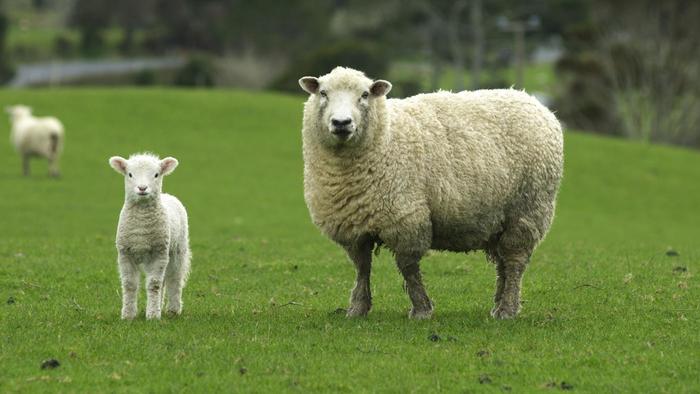


The Spirit testified to me that the Lord does indeed have a special role in leading those who are concerned with the care and nurture of his precious young ones. 

The peace and comfort of this message carried me through the next few days  my third child, Danny, was born on Christmas Eve  and I have called upon that divine promise many times during my years of parenting.


 ♥    ♥    ♥    ♥    ♥    ♥    ♥    ♥  


I happen to be very fond of sheep. But I will note that they are not particularly smart animals. Besides their intellectual weakness, they have virtually no defenses against predators. They can't run fast, they don't have teeth or sharp claws to fight with  they can't even make a scary face!


 They need a shepherd.


Most of us are smarter than sheep, but we are not smart enough, or strong enough, to win the battle against sin, grief and doubt alone.

We, too, need a shepherd.


The Lord is my shepherd; I shall not want . . . He restoreth my soul . . . I will fear no evil: for thou art with me; (Psalms 23)

I am the good shepherd, and know my sheep, and am known of mine. (John 10:14) 

And Jesus, when he came out, saw much people, and was moved with compassion toward them, because they were as sheep not having a shepherd: and he began to teach them many things. (Mark 6:34)

For thus saith the Lord GOD; Behold, I, even I, will both search my sheep, and seek them out. As a shepherd seeketh out his flock in the day that he is among his sheep that are scattered; so will I seek out my sheep, and will deliver them out of all places where they have been scattered in the cloudy and dark day. (Ezekiel 34:11 – 12)

Behold, I say unto you, that the good shepherd doth call you; yea, and in his own name he doth call you, which is the name of Christ; and if ye will not hearken unto the voice of the good shepherd, to the name by which ye are called, behold, ye are not the sheep of the good shepherd. (Alma 5:38)


\ \ \ \ \ \ \ \ \


At the time of Christ's birth, shepherds were not held in high esteem. Herding sheep was considered menial labor. Shepherds were thought to be dirty  and they often were, because they spent so much of their time with the sheep.

And yet, they were the first called to see the Savior's birth:


And she brought forth her firstborn son, and wrapped him in swaddling clothes, and laid him in a manger; because there was no room for them in the inn.
And there were in the same country shepherds abiding in the field, keeping watch over their flock by night.
 And, lo, the angel of the Lord came upon them, and the glory of the Lord shone round about them: and they were sore afraid.
And the angel said unto them, Fear not: for, behold, I bring you good tidings of great joy, which shall be to all people. 
 For unto you is born this day in the city of David a Saviour, which is Christ the Lord. And this shall be a sign unto you; Ye shall find the babe wrapped in swaddling clothes, lying in a manger.
And suddenly there was with the angel a multitude of the heavenly host praising God, and saying, Glory to God in the highest, and on earth peace, good will toward men. 
And it came to pass, as the angels were gone away from them into heaven, the shepherds said one to another, Let us now go even unto Bethlehem, and see this thing which is come to pass, which the Lord hath made known unto us. (Luke 2:7 - 15) 


Christian essayist Randy Alcorn wrote: Into this social context of religious snobbery and class prejudice, God’s Son stepped forth. How surprising and significant that Father God handpicked lowly, unpretentious shepherds to first hear the joyous news: “It’s a boy, and He’s the Messiah!”


It was not by chance that shepherds were chosen as witnesses. While Christ frequently affirmed His role as shepherd, He has also been manifestly recognized as "The Lamb." In these dual roles, Christ not only protects and guides us, but as the sacrificial lamb of God He gives his life to redeem us.


. . . Worthy is the Lamb that was slain to receive power, and riches, and wisdom, and strength, and honour, and glory, and blessing. And every creature which is in heaven, and on the earth, and under the earth, and such as are in the sea, and all that are in them, heard I saying, Blessing, and honour, and glory, and power, be unto him that sitteth upon the throne, and unto the Lamb for ever and ever. (Revelation 5:12-13)

He was oppressed, and he was afflicted, yet he opened not his mouth: he is brought as a lamb to the slaughter (Isaiah 53:7).

The next day John seeth Jesus coming unto him, and saith, Behold the Lamb of God, which taketh away the sin of the world. (John 1:29)

The Lord Jesus Christ He was born in obscurity, lived in difficulty and suffered all things — for us. For you, and for me.

All we like sheep have gone astray; we have turned every one to his own way; and the LORD hath laid on him the iniquity of us all. (Isaiah 53:6)
Surely he hath borne our griefs, and carried our sorrows: yet we did esteem him stricken, smitten of God, and afflicted. But he was wounded for our transgressions, he was bruised for our iniquities: the chastisement of our peace was upon him; and with his stripes we are healed. (Isaiah 53:4)


And we cannot repay him. He does not ask us to. He cannot expect us to.

So what does he ask of us?


After the Savior completed His atoning sacrifice, blood sacrifices were no longer a gospel ordinance. We are now required to offer the Lord “a broken heart and a contrite spirit” (3 Nephi 9:20). We are also asked to comply with the principles of sacrifice by obeying the commandments, offering precious gifts of love, time, and service, and remembering the sacrifice of our Savior. Our sacrifices deepen our worship, acknowledge our debt to God, and express gratitude for our blessings. (See Behold the Lamb of God, David Rolph Seely and Jo Ann H. Seely, April 2013)

Wherefore, redemption cometh in and through the Holy Messiah; for he is full of grace and truth. Behold, he offereth himself a sacrifice for sin, to answer the ends of the law, unto all those who have a broken heart and a contrite spirit; and unto none else can the ends of the law be answered. ( 2 Nephi 2:6 - 7)


From Elder Neal A. Maxwell:
The submission of one’s will is really the only uniquely personal thing we have to place on God’s altar. The many other things we “give,” brothers and sisters, are actually the things He has already given or loaned to us. However, when you and I finally submit ourselves, by letting our individual wills be swallowed up in God’s will, then we are really giving something to Him! It is the only possession which is truly ours to give!

And now I ask, can ye say aught of yourselves? I answer you, Nay.Ye cannot say that ye are even as much as the dust of the earth;Yet ye were created of the dust of the earth; but behold, it belongeth to him who created you.  (Mosiah 2:20 - 25)


This message resonates beautifully in the final stanza of Christina Rossetti's poem, In the Bleak Midwinter:


What can I give Him, poor as I am?
If I were a shepherd, I would bring a lamb;
If I were a Wise Man, I would do my part;
Yet what I can I give Him: give my heart.

 e  e  e  e  e  e  e  e


So, what will you give your Lord and Savior this year, on the day we celebrate His birth? Will you, like King Lamoni, give away all your sins to know Him? Can you find the faith and the courage to say, as Christ did, "Father, if thou be willing, remove this cup from me: nevertheless not my will, but thine, be done"? 


To be honest, I'm really not sure I can. But I'm pretty sure I can try to be kinder, to be more diligent in studying the scriptures, to pray more fervently, and to better magnify my callings at church and at home.

Like a good sheep would.


Image result for christ with sheep
My sheep hear my voice, and I know them, and they follow me.


Merry Christmas to all my fellow sheep. 


Wednesday, November 23, 2016

Three Lessons I Learned From My Appliances


When Wes and I got married, my maternal grandmother gave us her old microwave oven. It was a small black cube from the early eighties, not quite large enough to put a dinner plate in it. It had no buttons. To use it, you pulled the door handle to open it, put your food inside, pushed the door closed, and turned a plastic dial to start it.


Then you could leave the room to do something else, because it wasn't a powerful piece of equipment, and you had some time to kill.

We used that little microwave for thirteen years, until we moved into our current home and decided to get a new one.

Our new microwave was dazzling in comparison.


Disclaimer: These pictures are for illustration purposes only,
 and they may not actually reflect reality. (I have never in my life cooked that many carrots.)

Among its many stunning features, this microwave had a “30 seconds” button. We wondered what use that could possibly be. It didn't take us long to find out. This microwave could indeed make things warm in just half a minute. With a whole minute we could really heat things up. I thought about my paternal grandmother, who never owned a microwave. She was a widow for the last 25 years of her long life, and when she cooked, she froze her leftovers in little tin pie pans. Later, she would take a serving out and warm it in the oven for about an hour. I wondered what she would think of an appliance that could do the same job in two or three minutes.¹

I was used to doing other work while warming leftovers or cooking a frozen burrito, but since this one was so fast, it didn't seem worth it start something.

I was wrong. Thirty to sixty seconds is more time than it might seem to be. There are many things you can do in one minute or less. Here are a few ideas:

     Wipe crumbs off the countertop
     Put a few things back in the refrigerator (or wherever they should be)
     Do a little stretching
     Clean a light switch or two
     Read the scripture you have stuck on the refrigerator
     Make a phone call you've been putting off
     Pet the dog
     Declutter a drawer


I'm not saying that every second of your life should stuffed full with productive work. I am just reminding you that you might have more time than you think you have. Life is made of a lot of little minutes, and if you you use those well, you might not miss out on the big minutes. You wouldn't want to miss a magical moment, and those moments usually cannot be predicted.

              ✯        ✯        ✯        ✯        ✯        ✯      ✯  

I have written before about my wonderful washer and dryer.² I really do love them. But the washing machine has a quirk I find bothersome.

It has a digital display that shows how much time is left before the load is done. A very nice feature, I thought.

But it's not very accurate. I have sometimes looked at the display to see that it has 12 minutes left until the load is done, then I come back seven minutes later to see that is says 10 minutes left.


Okay, I admit this isn't a huge problem. When I mentioned my annoyance to my husband, he said “Well, it doesn't know how much longer it will take.”

“Yes it does!” I said. “Or it should! But if it really doesn't know, it shouldn't say it does!”

I have learned to live with this issue. But the lesson is important: Don't lie to anyone 
─ especially your kids  even about seemingly little things. Don't make up an answer or guess if you don't know. Your children (or friends or co-workers) won't lose their faith in you if admit to your non-omniscience, and they very well might enjoy finding the answer with you. But there are things we just don't know. That's what faith is about.


But I have commanded you to bring up your children in light and truth. (D&C 93:40)

I have long admired the parenting wisdom of Dr. William Sears:

"One of the best ways for teaching honesty to kids is to create a truthful home. Just as you sense when your child is lying, children will often read their parents’ untruths. If your child sees your life littered with little white lies, he learns that this is an acceptable way to avoid consequences. Don’t tell your child something is “gone” when it really isn’t just to make it easier for you to say he can’t have anymore. Sharp little eyes often see all and you haven’t fooled your child at all. You’ve just lied to him, and he’ll know that, since he knows you so well. Just say “no more now” and expect your child to accept that."

I like to trust everyone, but it doesn't take more than a couple of lies for me to stop believing in a person. Untruths are so often revealed. It's just not worth it. As Walter Scott said, "Oh, what a tangled web we weave, when first we practice to deceive.”


              ✯        ✯        ✯        ✯        ✯        ✯      ✯  


I am very grateful to have a working dishwasher. Our dishwasher, like many, I suppose, has a “Clean Light” a light that comes on when the dishes are clean. I have felt some small satisfaction seeing that message after a long day of cleaning. But as soon you open the dishwasher door, the light goes off.


This seemed to me very much like many of my weekdays. I could spend hours working toward a clean house, but as soon as the front door opened and the kids ran in from school, the “clean light” went out. Backpacks hit the table, mud streaked the floor and after-school snack crumbs flew.

I've realized now that many of the things we do every day are things we'll do again tomorrow. Some of those things are as simple and as universal as brushing your teeth or putting clothes on. But when you have young children (or teenagers), there will always be things you do over and over. And that's okay. We aren't meant to live in a perfectly sanitary environment. A little clutter and a little dirt probably won't hurt much.

I embrace the attitude Phyllis Diller showed when she said, “Cleaning your house while your kids are still growing is like shoveling the sidewalk before it stops snowing.”

And I love this insightful thought: “A household has to be tended if it is to flourish and grow. Housework is never 'done' in the same sense that gardening is never done or that God's providential involvement in the world is never done. Housework and gardening and God's providence itself are exercises not in futility but in faithfulness 
– faithfulness to the work itself, to the people whose needs that work serves, and to the God whose own faithfulness invites our faithful response.” 
   (Margaret Kim Peterson, Keeping House: The Litany of Everyday Life)

Another favorite of mine:

On Judgment Day, if God should say, 
"Did you clean your house today?" 
I will say, "I did not.
I played with my kids and I forgot."
And God might say "Good for you ─
That's just what I hoped you'd do."


              ✯        ✯        ✯        ✯        ✯        ✯      ✯  


These are small lessons. But I see something big in them. I see a life filled with appreciation for all things, big and small.

Be glad you have modern time-saving conveniences like these. Be grateful that you have people you love tracking dirt into the house. Be thankful to have spaces of time, short and long, that you can fill with work or service or looking out the window at the sky and the trees. Be grateful that you have truth to share, and truth still to learn.


Happy Thanksgiving!


1 To read more about my two grandmothers click here:
² To read about my washer and dryer, click here:


Friday, May 27, 2016

Once Removed


Note: I wrote this several years ago. I am posting it now because May is the time we honor our female forebears, and also to celebrate my Grandma Barnes' upcoming birthday  – she will turn 90 next week.

I was eight when I found out that my parents are cousins. I was standing at my mother's feet, enjoying the natural invisibility that makes children proficient eavesdroppers, as she explained it to a friend. "We probably should never have gotten married," she said, laughing.

I found myself quite indignant. What were you thinking? I shrieked inside. You don't marry your cousin! Even I know that!

As it turned out, they aren't first cousins – nothing so Old-Testament-times as that – but my father's great-grandfather and my mother's great-great grandfather are the same man. This makes my genealogy tilt strangely, the lines pulling together in places, like a sweater with a flaw in the knitting. Second-cousins-once-removed, I learned years later, is the proper label for my parent's relationship. (This means that I'm my own second-cousin-twice-removed, a fact I find amusing if not highly singable.)

It is the “once removed” aspect of this pedigree that has been most consequential in my life, because it means that I had the experience of growing up with grandmothers who, as first cousins once removed, literally came from two different generations.

My mother's mother, Elizabeth Barnes, was thirty-nine when I was born. My paternal grandmother, Lenore Measom, was forty when she gave birth to my father. I was the first grandchild for one family, perhaps the fortieth for the other. My uncle and my grandmother were classmates in high school.

Because my two grandmothers largely followed the paths laid out for them by the times in which they lived, they led notably different lives, despite having being born and raised within a few miles of each other. Knowing them both as I did put me in the privileged position of having an insider's view of two slices of history. I am only now beginning to see how enriching this was for me.

One gave birth seven times, every time in her home. The other had her four children in a hospital. One worked at her husband's side every day on their farm, while one wore a suit to go to work in an office.

One found a soldier in World War II: she met and married my grandfather while he was stationed in Salt Lake City. The other lost a soldier – her oldest son – in that same war.

One lived in the same house from the time of her marriage until her death, while the other has moved several times, each time to a nicer home, in upwardly-mobile fashion. One was a widow as long as I knew her, while the other is still comfortably married.

My younger grandmother, Grandma Barnes, is a strong believer in fitness and does aerobics regularly. Grandma Measom would have been dumbfounded at the idea of created exercise. She labored hard all her life, and if she had any leisure time, she would not have spent it trying to get her heart rate into its target zone.

Both were thrifty, although in different ways. Grandma Barnes loves a bargain and can hear a clearance sale downtown calling to her from her kitchen.  Grandma Measom was of the “make it do or do without” school.  My father told me how she once pulled up her living room carpet, which was very worn in the middle, and cut it in half, then swapped the halves and sewed them back together with a needle and thread. I was delighted with her ingenuity and struck with a desire to do something equally resourceful.

Despite their differences, though, as a child I saw both simply as loving, attentive grandmothers, which was all that really mattered to me.

I was influenced by their expectations for me, though their hopes were somewhat different. Grandma Barnes frequently told me how smart I was; how she knew that I could be anything I wanted to be. On the other hand, Grandma Measom was often heard to say that she didn't want her children and grandchildren to be smart, or rich, or good-looking, or admired by the world, but that she only wanted them to be good people who loved their families and loved the Lord. (At her funeral, my father shared this about her, then added, “I stand before you today as a testimony that the first part of her wish, at least, came true.”)

I was impressed by their faith through difficult times. I was struck by their strong work ethic, although their work was not the same. They both loved flowers and music and good food and family, and so do I.

The time in which I was raised was different from that of either of my grandmothers, or of my mother. I have choices they didn't have, luxuries they didn't expect, pressures they didn't face. Even on days when I long for a simpler time, I am grateful to live in this season. More than that, though, I am grateful for the women whose heritage and example have equipped me to live in it well.


My Paternal Grandmother, Lenore Measom


Grandma and Grandpa Measom standing outside their home. 
My Paternal Grandparents, Lenore and Ty Measom.
(Interesting fact: My husband's great-grandfather performed their
marriage and sealing in the Salt Lake Temple in 1922.)


My grandparents with their seven children, in 1942.
 The little one is my father.


My Grandmother, Elizabeth Gull Barnes


My Grandparents, Norm and Elizabeth Barnes
(To learn more about my Grandma and Grandpa Barnes's
 courtship and life together, click here.)

My Grandparents on their wedding day

My Grandma and Grandpa Barnes with their first three children.
My mother is the redhead in the white dress. 


A more recent picture of my maternal Grandmother, Elizabeth Barnes.
Happy Birthday, Grandma!

This picture, taken at my sister Polly's wedding, is one of the few pictures
that include both my Grandma Barnes and my Grandma Measom


Thursday, January 28, 2016

Act Your Age

I was sitting in the backseat of the car with my two younger sisters and my little brother. We were happily licking the ice cream cones our parents had treated us to at our visit to Baskin-Robbins. I was nine, and I would start fourth grade the next day.

This year's back-to-school was a bigger event for me than usual, because as a fourth-grader, I would be allowed to play on the “big kid's” side of the playground. The school playground was divided by a stripe of white paint, and first, second, and third graders were strictly prohibited from crossing the line. (Kindergartners had their own little playground, but of course we didn't want to play there.)


But the Big Kid playground! Many a third-grader had stood at recess with their toes just almost touching the painted line. We watched with envy and awe, knowing that our time would come.


My parents were in the front, and my mother turned to my father and said, with a touch of nostalgia, “Can you believe we have a child old enough to be in 4th grade?”

When I heard my mother say those words, I realized something I had never before considered: “My parents don't know they're old!”

How could this be? They were so obviously old-timers! How could this not be in their sphere of awareness?

(Actually, they were not that old. My mother was 29, and my father 33. But they were big, and could drive, and paid bills, and had kids. In my mind, they were practically fossils.)


٭    ٭    ٭   ٭    ٭    ٭    ٭    ٭     ٭


Nine years later:
I was a freshman in college, and I was driving home from school. It was a particularly nice fall day, and I was so charmed by the weather that when I passed a park, I succumbed to an urge to stop and swing on the swingset. The park was deserted, so I hopped on the swing and pumped until I was really swinging, enjoying the air on my face, the feeling of flying above the ground.


I don't know how long the little girl had been there before I saw her. She was standing a few feet away, in front of me, with a displeased look on her face. I slowed down and said hello.

She made no attempt to hide her disdain. “A grown-up,” she sneered, “playing on the swings?”

Oh. Well, I could see the problem. It was just a little misunderstanding, and I could clear it right up. “I'm not a grown-up,” I explained, confident that she would quickly realize her error, and stop looking aghast.

Not so. She shook her head and said, “Yes, you are.”

I'm not!”

She considered for a second, and then asked, “Can you drive a car?”

Oooh, good one. I had to confess that I could indeed drive. But I had a quick counter: “I'm not married.” I felt rather smug when I saw a bit of her confidence slip. But not for long.

Do you have a job?” she asked.

Yes. Well, kind of. I go to school every day, just like you do.”

She must have sensed my hesitation. “You are a grown-up.”

With that, she turned her back to me and walked away, leaving me sitting motionless on the swing, wondering.


٭    ٭    ٭   ٭    ٭    ٭    ٭    ٭     ٭


Seven years later:
I took my restless baby out to the church foyer. I saw a friend there, and I sat down beside her on the floor, leaning against the wall. We talked briefly, but soon she needed to get up and change her baby's diaper. I told her I would keep an eye on her two-year-old daughter.

The little girl moved over to her mother's bag, and pulled a banana out. She toddled over to me, handed me the banana, and said, “Open it?”

I didn't know if her mom wanted her to eat the banana, so I stalled for time, pretending that I couldn't do the job. She looked at me with some concern as my feeble attempts continued. Her mother came back after a minute, and I caught her eye. She nodded, signaling that I could peel the banana.

I said, “I'll try again,” and with a show of determined effort, I cracked the top of the banana peel. I handed it to my little friend, and she gave me an encouraging nod. “Big girl,” she said, praising my accomplishment, and gave me a pat on the head before she walked away.


٭    ٭    ٭   ٭    ٭    ٭    ٭    ٭     ٭


A little girl was visiting her grandmother, and after they had enjoyed some time together, the child asked, “Grandma, how old are you?”

Grandma, rather coyly, said, “I don't remember.”

Her little granddaughter had a helpful suggestion. “If you don't remember how old you are, you can look at your underwear. Mine says four.”


٭    ٭    ٭   ٭    ٭    ٭    ٭    ٭     ٭

Does anyone really know what age means? 

Of course, technically, it's the length of time that a person has lived; the space between birth and now. That seems manageable. (Especially if you are good at math.)

Maybe one reason this question has been in my mind recently is that in a few months, I will hit a notable age; one that is, I'll just say, an even number easily divisible into 100. (And I'm not turning 10).


But one thing that life  and raising seven children  has taught me is that people age differently. Still, this seems too simple. There must something else.

There is a old saying that reads “You are only as old as you think you are.” If that's true, I have no idea how old I am. Sometimes I feel really, really old (and look really old) but a lot of the time I feel like a goofy little kid, and I wonder why anyone thinks I might be in charge of something.

And then one of my children will say something so wise, or do something so mature, that I am stunned to think that I am the parent here. And I remember this truth: this child has a spirit as ageless and eternal as mine. We are mother and child, but we are also sister and brother. This is same relationship status applies to my mother, my grandmother, and my neighbor.


٭    ٭    ٭   ٭    ٭    ٭    ٭    ٭     ٭

"Nobody grows old merely by living a number of years. We grow old by deserting our ideals. Years may wrinkle the skin, but to give up enthusiasm wrinkles the soul."  (Samuel Ullman)

“Age has no reality except in the physical world. The essence of a human being is resistant to the passage of time. Our inner lives are eternal, which is to say that our spirits remain as youthful and vigorous as when we were in full bloom. Think of love as a state of grace, not the means to anything, but the alpha and omega. An end in itself.” ― (Gabriel Garcí­a Márquez, Love in the Time of Cholera)

"Whatever our age, capacity, Church calling, or location, we are as one called to the work to help Him in His harvest of souls until He comes again." ― (President Henry B. Eyring)

And Elihu the son of Barachel the Buzite answered and said, I am young, and ye are very old; wherefore I was afraid, and durst not shew you mine opinion. I said, Days should speak, and multitude of years should teach wisdom. But there is a spirit in man: and the inspiration of the Almighty giveth them understanding. Great men are not always wise: neither do the aged understand judgment. ― (Job 32:6 - 9)


“Everything in our life happens as though we entered upon it with a load of obligations contracted in a previous existence … obligations whose sanction is not of this present life, [which] seem to belong to a different world, founded on kindness, scruples, sacrifice, a world entirely different from this one, a world whence we emerge to be born on this earth, before returning thither.” ― (As quoted by Elder Neil A. Maxwell)

Maybe if I could see this more clearly more of the time, I would treat people differently. Maybe I would see both the innocence of childhood and the wisdom of years in the eyes of one person.


"Oh, to be 70 again!" 
Marjorie Pay Hinckley